
Pacific Northwest Institute
Democracy, community, and the long work of building durable institutions.
For much of the postwar era, democratic nations invested not only in treaties and markets, but in people, institutions, and shared civic life, laying the groundwork for decades of relative stability and cooperation.
That work was deliberate. It was sustained. And, for a time, it succeeded.

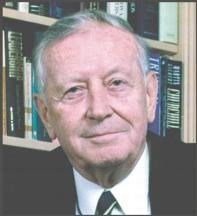
James R. Huntley, 1923–2019
A Practical Dreamer
James R. Huntley spent the better part of seven decades on a single question: how do democratic societies sustain the habits of cooperation over time? Not in theory, but in practice, through institutions, relationships, and the slow, unglamorous work of connecting people who might not otherwise find one another.
In April 1954, as a young Foreign Service officer stationed near the East German border, he stood at a knothole in a wooden fence in the divided village of Mödlareuth, Bavaria, eyeball to eyeball with a Soviet officer on the other side. On the Eastern side were banners, guard towers, barbed wire, and the families of people he could see on the Western side. He returned to that border in 1970 to find it more fortified than ever, and again in 1990 to find the walls gone, the village moving freely, and Germany peacefully reunited. That arc, from division to reconstruction, was not accidental. It was the result of deliberate choices about how to rebuild trust between societies that had, not long before, tried to destroy one another. Jim spent the rest of his life trying to understand how those choices were made, and how they might be made again.
His career took him from postwar Germany, where he worked on democratic reconstruction in the early 1950s, to the Ford Foundation, the Atlantic Institute, and the Atlantic Council. He helped build the infrastructure of the postwar liberal order not by writing about it, but by working within it: convening, connecting, corresponding, and gently insisting that the relationships between democratic societies required active maintenance, not passive assumption. His papers, spanning more than five decades of this work, are archived at the Hoover Institution at Stanford University.
The thesis he returned to throughout his life was deceptively simple. Democracy, combined with community, tends to produce peace. Not automatically, and not without sustained effort, but reliably enough to be treated as a working theory rather than an aspiration. He called it D+C=P, and spent decades testing it in practice. His book Pax Democratica (Macmillan/St. Martin’s Press, 1998; 2nd ed. 2001) lays out the intellectual case most fully. His memoir, An Architect of Democracy: Building a Mosaic of Peace (New Academia Publishing, 2006), tells the human story behind it.
For a full life, embrace a worthy cause. Mine is the unity of the democracies… Like-mindedness is not simply a gift of history; it must be cultivated.
James R. Huntley, in Who’s Who in America
I came to know Jim in the years before the Schoolhouse Conference, initially as a young assistant and, over time, as someone he trusted to help carry the work forward. He described himself, in a biographical note he wrote in 2013, as hoping that “the cause of international community among democracies will have its adherents among younger people, who one hopes can carry the torch beyond my generation.” During one of our last visits, he spent most of our time not talking about the state of the world (though he had plenty to say about that) but describing, with quiet urgency, why a particular person in Vancouver and a particular person in Seattle should meet. He explained their backgrounds. He described the overlap he had noticed. He asked me to help make it happen. It was a small act, and entirely characteristic. The institutions he helped build were large and often visible. The underlying work looked like this.
The Idea
The premise behind this work is straightforward, but not simple in practice.
Peace between democratic societies is not maintained by agreements alone. It depends on institutions that can absorb pressure over time, and on the people who operate within them. Those institutions do not maintain themselves. They require ongoing attention, sustained investment, and a form of stewardship that is rarely visible from the outside, and easy to take for granted when it is working.
Huntley’s deeper insight was that the postwar order was not a natural condition. It was constructed through deliberate choices about how to structure relationships between societies, how to create venues for cooperation, and how to build the informal networks that allow formal institutions to function. From the late 1940s onward, governments, foundations, universities, and civic organizations invested in this work across Europe and North America, and later across the Pacific. Much of it took place outside formal diplomacy. Much of it was never visible to the people it benefited.
The results were uneven, but in many cases durable. For several decades, these efforts contributed to a level of stability and cooperation that came to feel like the normal state of affairs. It was not. It was constructed, maintained, and in some cases taken for granted until the construction began to show wear.
What Huntley believed, and what his work tried to demonstrate, is that this kind of construction can be done again. Not by returning to old models, but by understanding why they worked and building something appropriate to the present. The Atlantic community was not inevitable. Neither is its successor. But it is imaginable, and imagination backed by patient institutional work is where such things begin.
Dungeness Schoolhouse Conference · Sequim, WA · 2013
The Work
The Pacific Northwest Institute emerged from a smaller, more local question: what would it look like to apply Huntley’s framework at a regional scale, with fewer resources but the same underlying assumptions?
The answer, at least in this iteration, was not a formal organization. It was a series of conversations among people who had spent time in different parts of the same system: diplomats, academics, business leaders, journalists, and civic organizers, many of whom had participated in earlier efforts of one kind or another, coming together to examine what still held and what no longer did.
The organizing question was whether the Puget Sound region, with its particular mix of international commerce, civic infrastructure, and geographic position on the Pacific Rim, might serve as a node in a renewed global network of democratic societies. Seattle was not chosen arbitrarily. It was chosen because the conditions for that kind of work were already present: an educated civic culture, global economic ties, and proximity to both Asia and the Atlantic world via Canada.


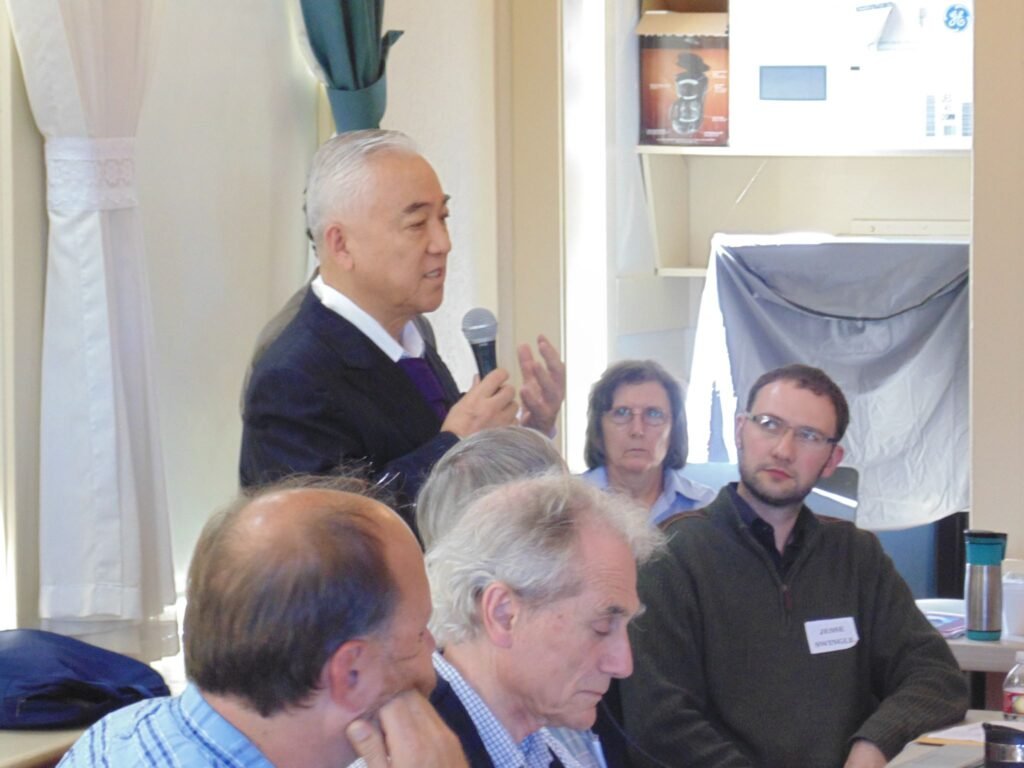
Over time, the work took on a loose structure. There were convenings, most notably the Dungeness Schoolhouse Conference in Sequim in 2013, which brought together educators, diplomats, business leaders, and civic organizers to examine the D+C=P framework in a contemporary context. There were working groups on civic education and democratic community-building. There were proposals for a Center for a Community of Democratic Nations, to be based in Seattle, with connections to likeminded organizations in Bonn, London, and beyond.
Not all of it came to fruition. What held it together was less a shared agenda than a shared orientation: the assumption that institutions matter, that they do not maintain themselves, and that the work of sustaining democratic cooperation tends to happen in ways that are difficult to see from the outside, and easy to stop funding before anyone notices the cost.
The Moment

The conditions that made Huntley’s earlier work possible have changed, and in some cases deteriorated. The postwar consensus that supported long-term institutional investment is under visible strain. Alliances remain in place, but the assumptions that sustained them are less stable than they once were. The informal networks that once connected people across governments, universities, and civic organizations have thinned.
At the same time, the basic dynamics have not disappeared. Institutions still require maintenance. Democratic societies still depend on relationships, not just rules. And in an era when commerce and technology have made the world more interconnected than at any prior point in history, the absence of governance structures that reflect that interdependence is increasingly consequential. Huntley believed this problem would eventually become undeniable. In 2026, that moment seems closer than it did when the Schoolhouse Conference convened in 2013.
There is reason for that to produce urgency rather than despair. The people who rebuilt democratic cooperation after the Second World War were not working from a template. They were constructing one, under difficult conditions, with incomplete information, and without any guarantee that it would hold. What they had was a clear analysis of why the previous arrangements had failed, a practical theory of what might work better, and the patience to do the slow work of institution-building rather than waiting for conditions to improve on their own.
That disposition, clear-eyed about the problem, patient about the work, and quietly insistent that something better is imaginable, is what Huntley spent his career modeling. It is not a bad place to start again.
Continuity
This site exists for a few different audiences, and it is worth being direct about that. For people who worked with Jim or followed his ideas, through the Schoolhouse Conference, the Council for a Community of Democracies, the Atlantic community, or any of the other threads of his long career, this is a place to find one another and to find the record of that work. The background documents, proposals, and conference materials produced through PNWI are available on request. His broader archive, spanning more than five decades and 180 linear feet of documents and correspondence, is held at the Hoover Institution at Stanford University.
For people who are encountering these ideas for the first time, the most direct entry points are Huntley’s own writing. Pax Democratica (Macmillan/St. Martin’s Press, 2001) makes the core argument in full. An Architect of Democracy tells the story of how he came to it, and what it looked like to spend a career acting on it.
For anyone who is curious about the domain in the email address that connects to this page: [email protected] has been in use since the early days of this project, and the address has outlasted the organization that created it, which feels appropriate. Jim used his @pnwi.org address until he passed in 2019, and I use mine still.
And for anyone who sees something in this work worth continuing, whether that means a new organization, a new conference, a new proposal, or simply a conversation, the invitation is open. The problem Huntley spent his career working on has not been solved. If anything, it has become more legible. That seems like a reasonable place to start.